For decades, regional Australia has been framed as somewhere you leave in order to make meaningful cultural work. The Regional, now showing at Warrnambool Art Gallery, flips that assumption on its head, positioning the regions not as a periphery, but as a powerful centre of contemporary artistic thinking.
Running until 15 March 2026, The Regional brings together five solo exhibitions by artists whose practices are shaped by regional life, landscapes, and histories. Curated by Aaron Bradbrook and Micky Schubert, the exhibition features Atlanta Eke, Gus Franklin, Paul McCann, Bronwyn Razem and Peter Tyndall, spanning fashion, sound, performance, weaving and conceptual art. It is playful, precise and deeply thoughtful, managing to feel both accessible and quietly academic in the way the best contemporary exhibitions do.
Where: Warrnambool Art Gallery, 26 Liebig Street, Warrnambool
When: Until 15 March 2026
Tickets and Information: Head here.
Keep up to date with all things arts, exhibitions and stage here.
View this post on Instagram
At its core, The Regional interrogates the long-standing metropolitan to regional divide that has long centred Australian arts discourse for decades. Bradbrook puts it plainly: “Too often regional arts practices and institutions are positioned within a dichotomy of metropolitan (centre) and regional (periphery).” This exhibition doesn’t just challenge that idea, it dismantles it, asking where the centre actually is, and whether it exists at all.
That question is explored through five distinct voices, each grounded in place yet reaching far beyond it.
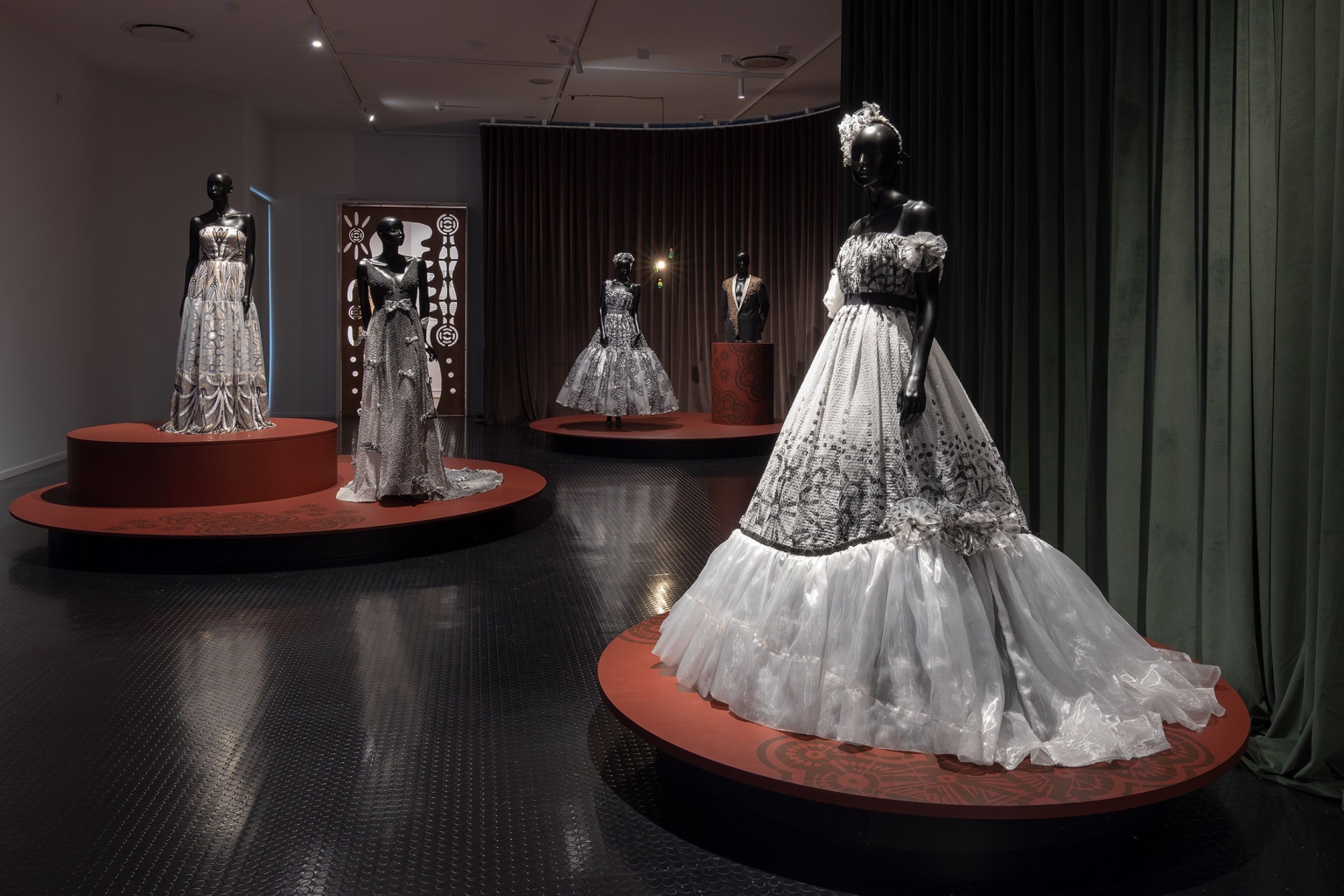
Paul McCann’s The Debutante is an immediate showstopper. The Marrithiyel fashion designer reclaims the colonial ritual of debutante balls, spaces historically used to enforce rigid gender, racial and social codes. Studio Bright transforms the gallery into a ballroom, within which McCann presents garments that shimmer with defiance and reverence. Central is a painstaking recreation of his grandmother Elizabeth Clarke’s 1952 debutante dress from Darwin. From this deeply personal foundation, McCann builds a series of works that weaponise glamour itself, turning European fashion traditions into acts of protest, reclamation and cultural pride.
View this post on Instagram
If McCann’s work glitters, Atlanta Eke’s A Streetlight Named Empire flickers. The two-part, surreal musical theatre work unfolds over time, beginning with a sculptural installation of salvaged Warrnambool streetlights and culminating in a live performance on the exhibition’s final day. Set against the backdrop of 1990s Victoria and the Kennett government’s privatisation agenda, Eke’s work is sharp, satirical and strangely tender. It asks how policy reshapes bodies, communities and public space, and it does so with humour, theatricality and a keen political edge.
View this post on Instagram
There is a deep sense of continuity and care in Bronwyn Razem’s Gunditjmara Country. A master weaver born and raised in Warrnambool, Razem presents her first public institutional exhibition on her Country, a moment of significance for both artist and gallery. At the heart of the exhibition is a newly commissioned eel trap basket, referencing the Gunditjmara people’s sophisticated aquaculture systems. Dyed in unexpected colours, the work honours tradition while acknowledging culture as a living, evolving practice. It is quietly powerful, grounded in matrilineal knowledge and future-facing in its vision.
View this post on Instagram
Sound becomes a carrier of memory and place in Gus Franklin’s The Edge of Forever. Best known as a member of Architecture in Helsinki, Franklin transforms the gallery foyer into an immersive sonic environment using field recordings from Port Fairy, layered with generative composition techniques driven by scientific data. The result is never the same twice. Activated by the listener, the work unfolds as a love letter and interrogation of home, blending the real and the imagined into an ephemeral sound world anchored firmly in south-west Victoria.
Rounding out the exhibition is Peter Tyndall’s The Blue Horizon, a deeply personal meditation on family, loss and interconnection. Based on a poem written by his late partner Christine during a holiday at Bridgewater Bay, the work carries the emotional weight of lived experience. Tyndall’s return to scatter the ashes of Christine and her family infuses the piece with profound intimacy, reminding us that conceptual rigor and emotional resonance are not mutually exclusive.
View this post on Instagram
Together, these five exhibitions form a compelling argument for regionality as a site of innovation, reflection and cultural leadership. The Regional does not ask for validation from elsewhere. It stands firmly where it is, confident in its voice and generous in its invitation.
For visitors, this is not just an exhibition to see, but one to sit with. To listen, to feel, to reconsider what we mean when we talk about place. In Warrnambool, the centre feels expansive, porous and alive.
For full information on The Regional presented at Warrnambool Art Gallery, head here.
The current most read stories on Forte

11 June 2026
June at Geelong Arts Centre arrives like a current of stories and sound, carrying audiences from intimate confessions to thunderous…
11 June 2026
These school holidays, State Library Victoria is transforming into a playground of imagination, where cardboard cars become tickets to adventure…
9 June 2026
Local galleries are turning heads, presenting works worthy of the Louvre Museum from international showcases, national prizes, to Australian exclusive…
9 June 2026
This July, Civic Hall in Ballarat will transform into a space where air and imagination converge. From 10 to 12…
3 June 2026
Her Majesty’s Theatre Ballarat is alive with performances this June, offering comedy, theatre, and music that span intimate storytelling to…
3 June 2026
Cindy Tong has been on our radar for a while. The ceramic artist and potter from Gippsland has developed a…
2 June 2026
This winter, Chadstone is stepping beyond the shopping bag and into the spotlight, unveiling Light to Night, a month-long festival…
2 June 2026
Today, Melbourne’s trams take on a new life, gliding through the city as moving works of art. The First Peoples…