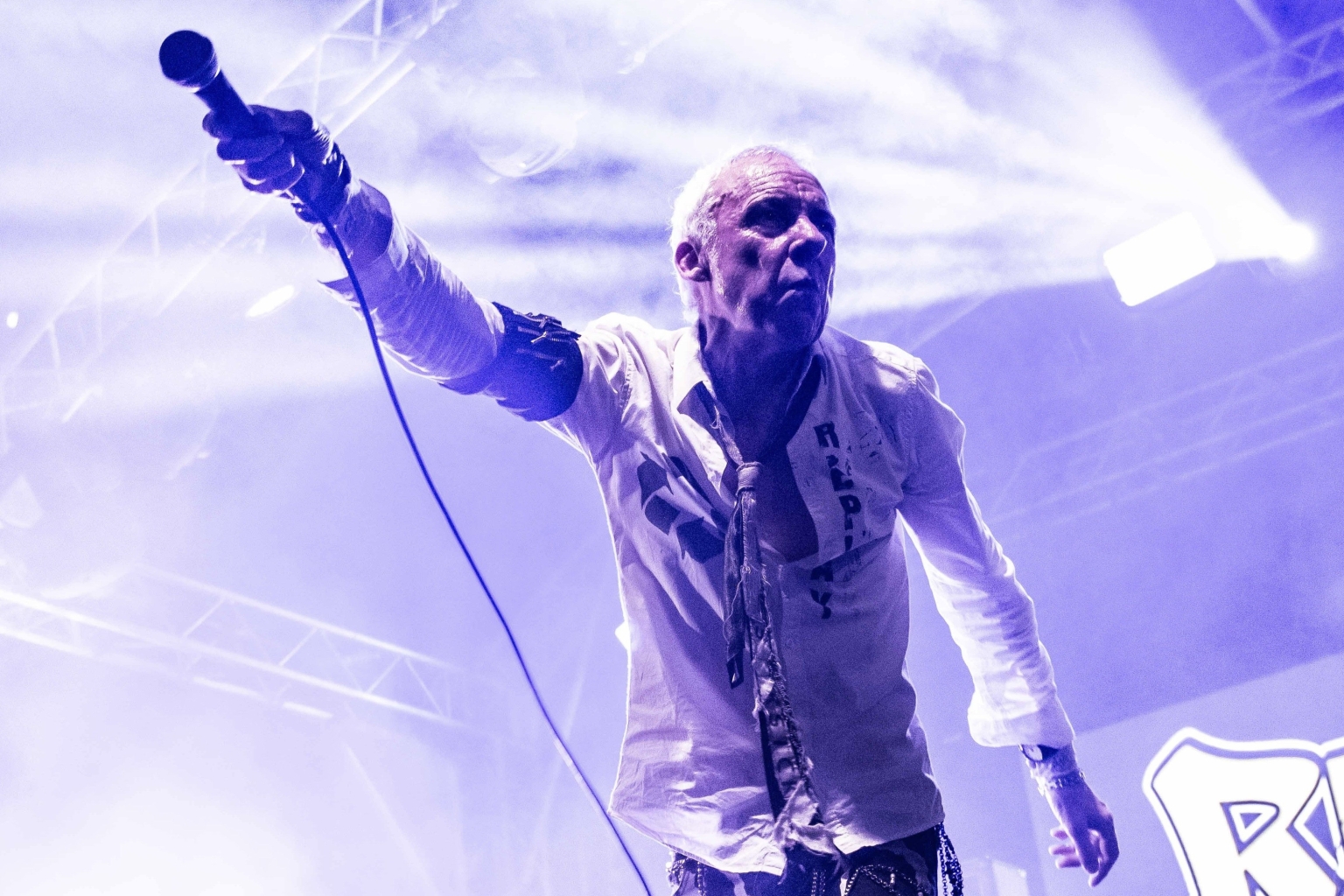
If you ever want to explore the intricate music scene web of genre inceptions, their pivotal pioneers, and their external influencers and pedestals, look no further than famed journalist Steve Wide and his book series A Field Guide To. The Punk book captures the timelines of the defiant music genre, the one he notes as changing the game for music accessibility – “After punk, music was fair game.” Whilst there are notable big players like Sex Pistols, The Damned, Iggy Pop, Ramones, New York Dolls, and of course The Clash, there is a world of bands who contributed to setting up the genre. The British birth of punk was further uplifted by The Strangler, Generation X, and a band who broke a bunch of ground, not just on stage, but in music history, The Adverts.
Whilst their reign only lasted from 1976 until 1979, The Adverts, TV Smith (Tim Smith) on vocals, Gaye Advert (Gaye Black), Howard Pickup (Howard Boak), and Laurie Driver (Laurie Muscat), are one of the few bands of that era to have any commercial chart success. On top of this, Gaye Advert was also often cited as the first female ‘punk’ musician. They’re a band who opened the door to floods of punks to pierce into the charts, and inspired females to flock to bands.
To celebrate the first wave punk movement and the hits that made it happen, frontman TV Advert has been heading around the world playing both solo shows and with bands. Now he touches down in Australia this April for a slew of shows from Easter weekend including Young St Tavern Frankston on Thursday 2 April, The Tote Collingwood on Friday 3 April, Barwon Club Geelong on Saturday 4 April, and Melbourne’s Last Chance Rock’n’Roll Bar on Sunday 5 April.
Ahead of his long flight, the decorated punk discusses the bands celebrated albums, the foundational days of punk, and the lasting legacy of the band.
Keep connected to your live music scene here.
– You formed The Adverts in 1976, during the very early days of punk. Can you share what inspired you to start the band and how the formative punk scene shaped your musical direction?
People tend to forget that there wasn’t a defined British punk rock scene in 1976. There were a few bands around, like the Sex Pistols, who’d played their first few gigs, The Ramones had played in London a couple of times, and there was an American fanzine called “Punk” – a word which no one in the UK thought was right for us, but apart from that there was just a shared feeling that music needed changing. I’d had a band in rural South West England in 1975 and no one was interested, so when I started reading about the Sex Pistols gigs in London I got a feeling that this was what I’d been looking for and knew I had to move there and be a part of it.
‘Gary Gilmore’s Eyes’ was a massive hit and brought The Adverts into the public eye. How did the song come together and what were the reaction you received when it became a top 20 hit?
At the beginning of 1977 the British media was full of reports of Gary Gilmore, who was on death row in the US for a couple of murders he’d committed while robbing gas stations. The coverage was all very distasteful and unnecessary, and I decided to out-do them and make an even more bad taste song out of the story. It seemed a very punk thing to do. The clincher was when I read that Gilmore was donating his eyes for transplant after his execution, saying at least he would have done one good thing in his life. I speculated about whether the recipient might know whose eyes he now had, and it developed into a kind of gothic horror story. It created a ripple of shock waves in Britain because people were already primed to believe that anything to do with punk was bound to be shocking, but really I was mainly trying to satirise the media reportage.
The Roxy Club was a pivotal venue in punk history. What was it like playing there in the early days, and how did it influence the band’s development?
It was a great place to develop and find our feet, particularly in the early days before there was too much interest in it. There weren’t too many people there for our first gigs, and those that were didn’t mind that we were basically amateurs and would sometimes make mistakes, or songs would stop in the middle and then start up again. The audiences knew that this was part of what punk was all about. The occasional journalist who came to the Roxy and criticised us for our lack of ability just didn’t get it.
The album Crossing the Red Sea with The Adverts is often cited as one of the greatest punk albums. How do you look back on that record now? Was there anything about it that surprised you upon its release?
I still love that record. We had a great producer in John Leckie, we were able to record in a great studio – Abbey Road – and the band really rose to the occasion. I’m delighted that the record has stood the test of time. If you put heart and soul into your music it should do. I thought we had something good as soon as it was finished – the only thing that surprised me really was that it dropped out of the charts after only one week. I tend to think now that we released it just as interest in punk was tailing off – we’d spent all of 1977 touring and didn’t get the record out until early 1978. Things were already changing.
How did your experiences with other bands like The Damned and Iggy Pop influence your music, both with The Adverts and in your later solo work?
I can’t say I was really influenced by them. I grew up listening to Iggy and loved the records, and it was a great feeling to be chosen to support him on tour in late 1977, but our course was already set by then. And the tour with The Damned in the summer of 1977 was a matter of two punk bands at the top of their form battling to outdo each other – in front of audiences who’d heard all about this new punk scene and were primed for the experience. They were exciting times.
Punk was known for its anti-establishment ethos, but your songs often had a political edge too. Was there a specific message you wanted to communicate through your lyrics at the time? How has that transitioned into the current political climate?
It’s hard to separate the anti-establishment message from the political message, they’re very much bound up with each other. There was a lot going on in the ‘70s for a teenager to take in – the whole complacency of Britain in that period combined with the sense of alienation from not fitting in to it. Those were the conditions that formed the punk scene, and sadly not a lot has changed. I think that’s why the songs still work.
Recently, some unreleased Adverts material has surfaced, including an early demo tape and a single. How do you feel about revisiting these old recordings, and what significance do they hold for you now?
These came about basically through the efforts of Henry Rollins, who is a self-confessed fan of the Adverts. He sought out some early tapes and got a really good re-mastering job done on them which brought them back to life. Personally I don’t spend a lot of time worrying about heritage recordings – I’m happy to just have the two studio albums available – but I think these are nice souvenirs for collectors, great sound quality and beautifully packaged.
How do you view the ongoing legacy of The Adverts within the broader punk scene today? Is there any particular moment or achievement you’re most proud of?
As I’ve said, I still love Crossing The Red Sea, but I always loved the second album Cast Of Thousands too, even though it was hammered by the critics and our audience at the time – so badly that it was a major factor in us being thrown off our record label and the band breaking up. I never stopped believing in Cast Of Thousands, so to have people finally calling it a classic is possibly the one thing from the legacy of the band I’m most proud of.
You’re coming to Australia in April 2026. What can fans expect from your live shows in Australia, and how do they differ from your early punk performances? Will you be doing the acoustic show or bringing the band?
I’d love to bring my solo show to Australia another time, but this time it’s all about the fiftieth anniversary of the formation of The Adverts, so I’m very excited to be playing with a brilliant band backing me up, performing all Adverts songs in a way that makes sense in 2026. The songs aren’t going to be stopping in the middle or going wrong like they did at those first gigs at The Roxy. Well, I hope not! It’s going to be thrilling.
Finally, as a member of a band credited as one of the defining punk bands, what are your thoughts on how the genre has evolved? Is punk still an attitude?
It’s certainly an attitude. It’s about preserving your integrity and not being taken in by what you don’t agree with – which is harder and harder to do in today’s world. I don’t think you can think of it in terms of a musical genre any more, it’s become completely diverse, which is actually the way it started off and the way it should be. I tend to think that if a band calls itself “punk,” they’re not.
Tickets to the upcoming April TV Smith at the Barwon Club Hotel can be purchased here. Discover more about the tour here.
The current most read stories on Forte

5 June 2026
Melbourne Record Club are heading down the M1 for a day of diving into crates for the best wax additions…
5 June 2026
Yorke has always had a knack for turning vulnerability into verve, and with her new single break up season, she…
4 June 2026
Phillip Island will come alive next summer as Ocean Sounds Festival returns for 2027, promising a day of music, sunshine…
4 June 2026
CORE Festival will make its long-awaited Australian debut on Saturday, 28 November 2026, bringing its globally recognised blend of electronic…
4 June 2026
Funky grooves find a new home in Wallington this month as Italian restaurant and bar, Mona Cicchetti introduce Live n’…
4 June 2026
City of Yarra’s cherished winter music festival, Leaps and Bounds, returns in 2026 with a full ten-day programme, shining a…
4 June 2026
BIGSOUND is marking its 25th anniversary with a powerhouse first announcement, unveiling a new wave of international industry heavyweights alongside…
3 June 2026
The city that gave the world laneway dining and rooftop cinema is now embracing something quieter — and somehow louder….